In 2023 I set out to make my wife a ring.
She had lost her wedding ring, which is not the kind of thing she would want me to put on the internet, but it is true, and it matters to the story. I can’t hold it against her. She is a doctor. She pulls her gloves off a dozen times a day, and one day the ring came off with a glove and was gone. I should admit, a little sheepishly, that I had also never given her the engagement ring I thought she deserved. So I decided the replacement would be both things at once: a wedding ring that was also the proper solitaire engagement ring I still owed her.
I wanted the center stone to be something specific. Not a standard round brilliant in a standard setting, but a custom-faceted gem cut in the shape of a zinnia, in a particular shade I could see clearly in my head and could not find anywhere in the world. I went looking for real examples and hit a wall. Custom gem faceting is a small, deep craft, and the exact thing I needed to know was written down nowhere I could reach: what would this specific cut, in this specific color, look like rendered in garnet, or synthetic garnet, or synthetic sapphire, or moissanite. Each of those materials bends and splits light differently. Dispersion is the word for the fire, the way a stone fans white light out into color, and different materials do it to wildly different degrees. A design that sings in one stone can go flat and glassy in another, and there were no photographs anywhere of the exact combinations I was chasing.
So I built one. With ChatGPT’s help, over a stretch of evenings, I put together a small pipeline that took faceting designs and rendered them in three dimensions, accounting for the way light disperses and refracts and bounces around inside each material before it comes back out to your eye. I had never done anything remotely like it. I am not a gemologist and I am not a graphics programmer. But I could describe what I wanted, ask, correct, run it, look at the result, and ask again, and slowly the renderings started to look like real stones sitting in real light. There was no Claude Code or Codex at the time. Just my browser and lots of copy/paste.
The cuts themselves I did not design. Faceting is its own deep world, with a small community of people who invent these patterns and publish the diagrams for free. A faceting diagram is a precise thing, a set of angles and index positions that tells you exactly where to grind each facet. Here is one, “Fata Morgana,” so you can see what the machine was actually reading.
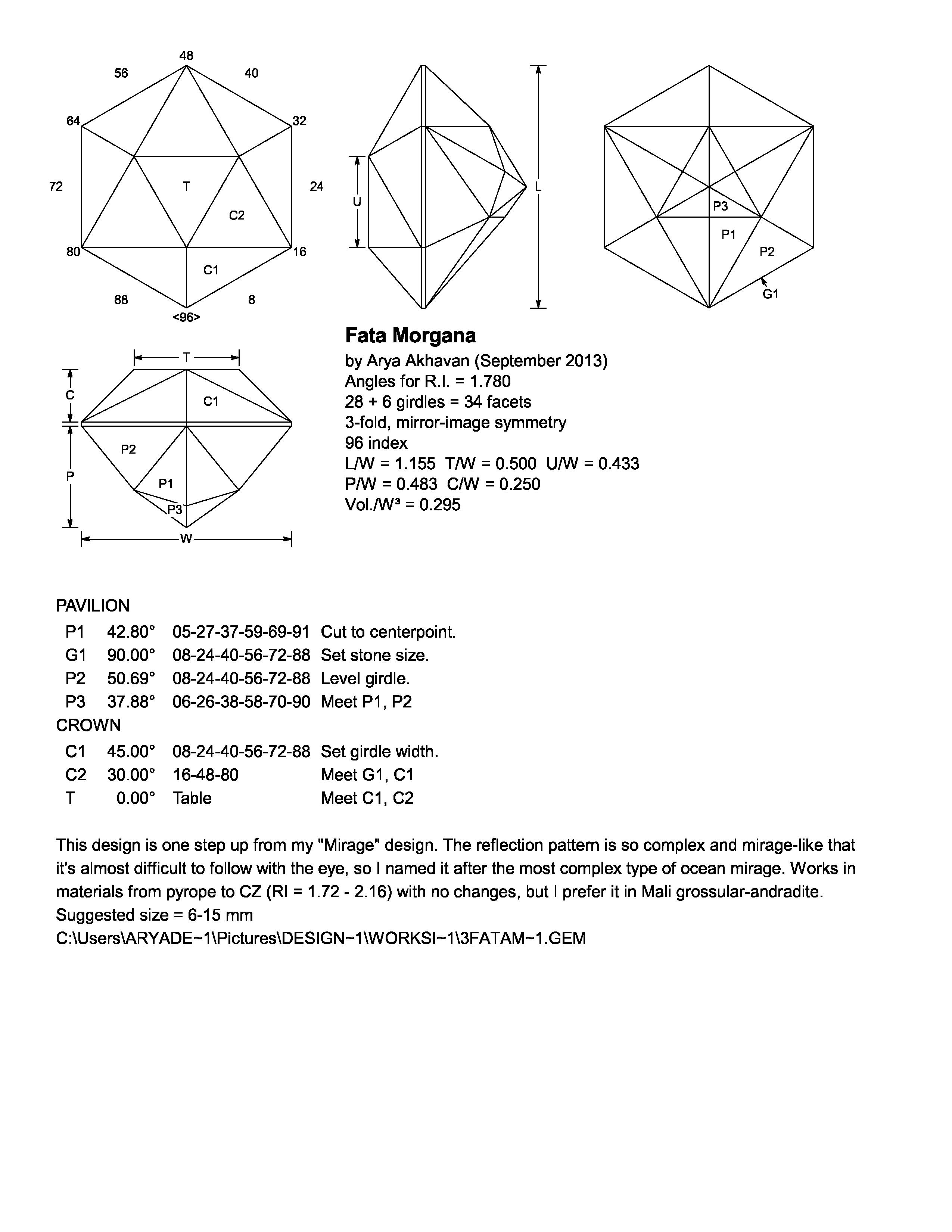
I pulled a whole community archive of these designs to render, and I kept circling back to one cutter in particular, Arya Akhavan. He is a physician, and he faceted many of his most intricate designs during medical training, which is about the busiest and most punishing stretch a person can have. One of his designs is literally named “Board Exam.” He gives them all away for free. I have never met him. I follow his work from a distance, the way you can admire a stranger’s obsession and recognize your own in it. I know what it is to go all the way into a thing that nobody asked you for. His were the designs I most wanted to see come alive. His own note on Fata Morgana even tells you it “works in materials from pyrope to CZ with no changes,” which is exactly the question I was trying to answer, so here it is answered three ways: the same cut as diamond, as moissanite, as rose garnet.
And then I did not stop at one. I let it run on all of them. Every design in the archive, a few hundred of them, rendered in every gem material I could find real optical numbers for, more than two dozen, from diamond and moissanite down through the garnets and the quartzes to opal and fluorite, each design turning three different ways so you could actually watch the fire move. It came to tens of thousands of animations, something like ninety-five gigabytes of turning stones. I built a little searchable catalog to browse them in, filter by the cutter, the shape, the material. I had set out to choose one gem for one ring, and I had rendered a museum of every gem I would never set. Not one of them ever touched metal.
We went to look at stones in person, hunting for a Padparadscha sapphire, and my wife fell for a synthetic diamond in a peach shade that was exactly right. We have been happy with it ever since. Diamonds, at least back then, came in a fixed set of cuts, so the whole zinnia question quietly became moot. The pipeline sits in a folder, unused. The tool did not win. And it was still one of the most important things I have ever built, for what it showed me.
What it showed me is that these models can hand you a capability that sits miles outside your own. I think sometimes about the power that reading gives us. Someone else does the deep work of understanding a thing, for years, and then compresses it down so that you can absorb it in an afternoon. You get to stand where they stood without making the whole climb yourself. A large language model, an LLM, does the same thing, except it is live. It does not only hand you what someone already wrote down. It responds to your exact question, in your situation, and works the problem alongside you. I did not have to become a gemologist or a 3d artist to see my gem. It handed me the capability itself, not a summary of one.
Once you have felt that, something shifts in what you are willing to depend on. I do not want to pay rent for someone else’s knowledge. When the easy path is to wire in someone else’s black box and be done in a weekend, I keep choosing the longer climb instead, because the climb is far shorter than it looks.
We picked a diamond. The ring is beautiful and the pipeline is unused, and I would build it again tomorrow. What these machines give you is the ability to experiment your way into a space that used to be shut, and to come out the far side understanding it. That is the same gift reading gave us, sped up and made to talk back, and it is the reason I keep building things I have no business building.
The designs above are Arya Akhavan’s, pulled from the free faceting archive at The Gemology Project, where he and hundreds of other cutters give their work away. If you want the actual machinery, how the renderer fakes the physics of light inside a stone, and how a whole catalog of gems turns out to be a single database query, I wrote that up in a companion piece, because it is a different kind of pleasure and it earned its own room.